A cultural vision taking shape in Moose Jaw

Imagine a city where every cultural group feels seen, heard, and valued. In Moose Jaw, that vision is taking shape through the city’s first-ever Cultural Plan. Initiated by the Cultural Diversity Committee, the plan aims to weave the rich tapestry of Moose Jaw’s diverse communities into the very fabric of the city’s future.

Officially adopted by the City of Moose Jaw in 2024, the Moose Jaw Community Cultural Action Plan now serves as a framework to strengthen the city’s cultural landscape in the years to come. The journey began in 2021, when committee members recognized a gap in public awareness around the many diverse cultural groups, programs, and events in the community. What followed was a thoughtful process that included research, community consultations, and collaborative planning.

Throughout the multi-year effort, the committee remained focused on one priority: ensuring that diverse communities were meaningfully included and engaged at every step.

“Diversity is a core community-identified priority. So, when you look at our Cultural Plan, there’s a list of priorities, and one of those is diversity,” says Craig Hemingway, director of strategic growth, City of Moose Jaw.

The community responded well, with 20-30 people regularly attending cultural planning meetings. One major challenge identified early on was that cultural groups did not have enough resources, and there was a lack of collaboration. Hayley Hart-Rushinko, manager of communications and Indigenous relations, City of Moose Jaw, says that “Because [organizations] don’t have a ton of time or a ton of resources, they end up working in silos.”

Involving many voices in the planning process had a twofold impact. First, it allowed the committee to hear diverse perspectives and move forward with a shared understanding. It also created opportunities for groups to connect, collaborate, and raise awareness of their work.

“The past few years, we’ve been able to host consistent free public events … along with meeting with the cultural committee members on a regular basis, who might not otherwise get a chance to speak with each other and even just collaborate within a year,” Hart-Rushinko says.

For communities that are looking to start on the cultural planning journey, Hemingway says that consistency is key for keeping the community engaged through a long process.

“As a member, I want to be in a meeting, and at the next meeting, to see where that input went, and how it was used and the progress that’s been made,” he says.

Hart-Rushinko says that developing this plan helped the city build a stronger, more connected community, while raising awareness among community groups. The biggest challenge, she adds, is “making sure that [groups] stay engaged, because these plans can take a lot of time, and sometimes it can seem like not a lot is happening — it just takes patience to build that foundation.”

National Volunteer Week April 27 – May 3

Saskatchewan’s sport, culture and recreation system is nourished by the province’s 330,000 volunteers and from Apr. 27 – May 3, the dedication of volunteers will be celebrated across the country under the theme of ‘Volunteers Make Waves.”

It is because of volunteers’ commitment that Sask Lotteries’ funding can make a difference in volunteer-led sport, culture and recreation programs.

Sask Lotteries knows that every second a volunteer gives to the community, an innumerable number of individuals feel the impact. As part of the celebration, Sask Lotteries, along with Sask Sport is saying thank you to the volunteers in Saskatchewan, who help make the more than 12,000 lottery-funded sport, culture and recreation activities possible.

When thanking volunteers on social media, organizations are encouraged to use the hashtags: #VolunteersMakeWaves, #NVW2025

For more information on the week and access to National Volunteer Week assets, check out Sask Sport.

GTNT Shines Spotlight on Indigenous Stories 

By Ryan Flaherty for Sask Lotteries 

For Indigenous people, storytelling serves an important purpose, not only in preserving their history and cultural traditions through the generations but in sharing that culture with the broader community. 

Based in Saskatoon, the Gordon Tootoosis Nikaniwin Theatre has spent the last quarter century telling stories and celebrating Indigenous culture while providing opportunities for Indigenous talent both established and emerging. Each year, the GTNT (formerly known as the Saskatchewan Native Theatre Company) stages multiple, professional productions that are created and performed by Indigenous artists, with the aim of entertaining, educating and empowering their audiences. 

“It’s important, being able to share our stories and openly speak our language and engage with our culture,” artistic director Jennifer Dawn Bishop said. “Indigenous theatre also highlights the strength and resilience of Indigenous Peoples and communities.” 

In addition to its annual season of performances, the GTNT also hosts a variety of programs aimed at fostering the next generation of Indigenous storytellers. With support from funding partners like Sask Lotteries, they have been able to expand these programs while keeping them free, accessible and inclusive. 

One such program is the Performer’s Playhouse summer day camp for inner city youth. In addition to helping with essentials like craft items, Sask Lotteries funding also covered the cost of transportation for the campers, removing a potentially significant barrier to their participation. 

Other programs offered by GTNT include New Voices, a six-month paid residency that helps young Indigenous writers learn how to put their work on the stage, and Circle of Voices, which teaches youth artistic and theatrical skills while incorporating traditional Indigenous cultural practices. 

“Theatre has always been an outlet for me. The fact that it also incorporates my culture was a bonus. It’s nice to be able to meet people in your age range that can understand (to some degree) what you’re going through,” a former Circle of Voices student said. 

In addition to helping with program delivery costs, funding support from Sask Lotteries also serves a broader purpose of connecting the GTNT with a wider audience. 

“Without [it], we wouldn’t be able to bring our work to the communities outside of Saskatoon or be able to perform outside our offices,” Bishop said. 

The positive impact is evident not only in the cultural enrichment that GTNT provides through its performances but the opportunities that it provides for Indigenous voices to tell their stories and the doors it opens for youth to pursue a career in theatre or the performing arts. 

“Each show we do, it celebrates how far we have come as a society and how proud we are that we get to tell our stories our way,” Bishop said. 

Saskatchewan German Council ensures German heritage remains strong in Saskatchewan

Written by Ryan Flaherty for Sask Lotteries

Whether by birth or by heritage, everyone comes from somewhere, and for nearly a quarter of Saskatchewan residents that somewhere is Germany. 

According to the last census in 2021, German- Canadians make up 24.7 per cent of the population. And while many now call Canada home, they maintain a strong connection to their German heritage thanks in part to the efforts of the Saskatchewan German Council. 

For the last four decades, the Saskatchewan German Council (SGC) has worked to preserve German culture and share it with the rest of the province. Since 1987, those efforts have been bolstered by funding from the Sask Lotteries Trust Fund for Sport, Culture and Recreation, helping the council support nearly 30 member groups with programs and projects that promote German- Canadian culture and strengthen its ties to the broader community. 

“It is very exciting to always rediscover German culture in Saskatchewan with new angles and perspectives,” SGC executive director Gabriele Waidelich-Harrison said. 

Some of the many SGC initiatives that have benefited from Sask Lotteries’ support include an annual award ceremony honouring volunteers and youth who have made notable contributions to the German-Canadian community, an online “Collection of Immigration Stories” that highlights the diverse backgrounds of people of German descent who settled in Saskatchewan, and a multicultural cooking series called “Culture in the Kitchen,” which sees SGC participants get together with other cultural groups to share regional dishes and food traditions. Indigenous, Chinese, Nigerian, and Filipino groups are among those who have taken part in the series since its introduction in 2016.

“It’s such a pleasure to work with other community organizations, discovering the commonalities that bind us together,” Waidelich-Harrison said. 

In addition to supporting specific projects and initiatives, Sask Lotteries funds have also helped the SGC achieve its broader mandate of supporting its member groups through project grants, German Language School funding, and even helping to pay for costumes and travel expenses for performing groups. 

In short, the support allows the SGC and its members to maintain and connect with a strong and vibrant German-Canadian community in Saskatchewan, one it hopes will continue to thrive for generations to come. 

“The SGC is immensely proud to be trusted with Sask Lotteries funding, enabling us to make meaningful contributions to Saskatchewan’s cultural landscape,” Waidelich-Harrison said. “(We) take great pride in adding to the cultural vibrancy of Saskatchewan.” 

‘Teepee Teachings’ bring hands-on learning to rural Sask. communities

Written by Ryan Flaherty for Sask Lotteries

When most people think of a library, they tend to think of it primarily as a place where people can borrow books and other media or learn about a specific subject. And while that’s certainly true, libraries also serve an important role as community hubs that bring people together and connect them with a wide variety of resources.

That role is especially vital to folks living in rural areas, and in west central Saskatchewan it is filled by the Wheatland Regional Library (WRL), which serves more than 100,000 residents in 130 communities with 45 branches throughout the region.

For the last three years the WRL has held a Truth and Reconciliation speaker series as part of Culture Days celebrations across the province. This year, with funding support from Sask Lotteries and Sask Culture, the series featured a more hands-on approach led by Indigenous educator and knowledge keeper Jasmyn Albert, who brought her Teepee Teachings workshops to six different WRL branches.

“Consistently, we’re hearing more people saying, especially around Truth and Reconciliation, yes it’s been a national day for a few years now but still many of our smaller communities especially are feeling like they didn’t learn about it when they were in school and are feeling very lost with regards to where to start,” WRL branch manager Desirae Munro said. “Offering something that allows people to come out, we’ve been getting really positive feedback.”

Workshop participants learned about the cultural significance and modern usage of the teepee for the Plains Cree people and took part in a teepee raising. The funding from Sask Lotteries allowed the WRL to expand the number and geographical range of the workshops, and as a result more than 200 people were able to take part. Being associated with Culture Days and having access to its marketing and advertising portals further strengthened the reach and impact of the speaker series.

The additional funds also provide a trickle-down benefit for the WRL that extends beyond the workshops themselves.

“We can then take some of the budget money that was set aside for something like this and redistribute it to other library services that we’re able to offer,” Munro explained.

That, in turn, helps support the WRL’s mission to create spaces that connect people to resources and strengthen communities. While this year’s speaker series visited six library branches, there’s hope that it will continue to grow in future years.

“Obviously we’re not able to send somebody to all 45 branches but it would be amazing to be able to do that someday,” Munro said.

Sage Hill Writing authors homegrown success story 

Written by Ryan Flaherty for Sask Lotteries 

When the Saskatchewan School of the Arts closed its doors in 1989, it left a void in the province’s creative landscape, but thanks to a dedicated group of writers the spirit of that artistic hub lives on through Sage Hill Writing, which marks its 35th anniversary this year. 

Sage Hill’s mission is simple: to provide opportunities for writers of all experience levels to hone their craft with the help of other writers through an assortment of retreats, programs and other events. 

What began as a mere five days of courses in 1990 has since grown into a full slate of programming, drawing writers not only from Saskatchewan but across Canada. Some are just setting out on their writing journey while others come seeking inspiration, feedback and support for their work from fellow members of the writing community. 

“Writing is often a solitary action. Through Sage Hill, writers form life-long community bonds and often return to work on new projects.”

Tara Dawn Solheim, Executive Director

A typical Sage Hill course includes three main elements: group sessions for sharing ideas and techniques, one-on-one feedback with instructors, and personal writing time. There are also publishing workshops, tips on grant writing and even sessions dedicated to mental and physical health. The courses are led by experienced writers, with literary heavyweights like Jane Urquhart, Lorna Crozier and Guy Vanderhaeghe among those who have served on the faculty over the years. 

The proof of concept is on the bookshelves. Roughly 850 works have been published by writers after they participated in a Sage Hill retreat, and the list of notable alumni includes best-selling novelist Lisa Moore, Griffin Prize-winning poet Sylvia Legris and several Saskatchewan Book Award winners. 

But Sage Hill isn’t just focused on getting things published. It’s also intent on helping the next generation of writers find their voice through an assortment of youth workshops. Thanks to the support of funding partners like Sask Lotteries, these workshops are available free of charge, reducing barriers to participation and providing opportunities for young writers from a diversity of backgrounds to find a community. In recent years, the addition of online programs has allowed for even greater accessibility. 

“It has been amazing to watch the community blossom with the mix of virtual and in-person programming,” Solheim said. 

And while the writers themselves enjoy the direct benefits of enrolling in a Sage Hill program or workshop, the ripple effects extend well beyond that. 

“Sage Hill’s programs provide a supportive and educational environment to help writers find and trust in their own voices. The voices of these writers in turn contribute to the cultural vibrancy of our Saskatchewan community,” Solheim said. 

It’s a homegrown success story with many chapters yet to be written. 

The volunteers behind the North American Indigenous Games

Among the 12,000 sport, culture and recreation programs funded by the Sask Lotteries Trust Fund, the North American Indigenous Games (NAIG) captures a unique combination of sport and culture.

In 2023, Team Saskatchewan, compiled of more than 500 athletes and over 130 volunteers captured the championship title at the 10th edition of NAIG in various venues across Kjipuktuk (Halifax), Dartmouth, Millbrook First Nation and Sipeke’katik in Nova Scotia.

For NAIG to take place, it takes numerous individuals volunteering their time and energy in the different regions, to bring together an event that unites people, from across North America.

NAIG is held once every four years, but the work behind the scenes never fully comes to end for the host and provinces. Once the multi-sport event concludes, the preparation for the following one begins.

Team Saskatchewan’s Chef de Mission works alongside countless others to organize over 50 different teams. The volunteers set the scene for each NAIG and are the individuals who bring the event to life for Saskatchewan’s athletes.

“NAIG provides an incredible experience for anyone involved and brings together a lot of people from across Turtle Island.”

Team Saskatchewan Chef de Mission, Mike Tanton

Mike Tanton has volunteered as Chef de Mission for seven Games, prioritizing an atmosphere that combines the competition of sport with the celebration of Indigenous culture.

“The cultural portion of [NAIG] adds so much and makes it that much more meaningful,” shared Tanton.

“We see the kids when they come from their communities. We see them as they train leading up to the Games and at the Games – seeing their excitement – those are the things that keep me involved.”

Volunteers can take on various roles, anything from organizing travel to staying on location with athletes.

“We had volunteers that were up and at the airport at 4 a.m. to make sure the kids were able to get through security and to their flights. They stayed there all day to make sure every team was checked in correctly.

“[The volunteers]really worked on establishing a relationship with our partners that we were working with, like WestJet. We want them to look at our kids as theirs, because if they are doing that the kids will be in good hands.”

Tanton advocates the importance of establishing a family environment for the duration of NAIG. His dedication to creating a positive environment for the kids shines through each step of the preparation process.

“Volunteers are with the kids 24/7, for nine days straight. The family atmosphere lets people know that you care.”

Team Saskatchewan’s volunteers become family to each other and the athletes, prioritizing their well-being during training, up until they return home following the Games.

Tanton’s philosophy suggests that when things are done for family, it is being done in the best way possible.

NAIG is a unique event that gathers people from all areas. The volunteer team is a collection of individuals with various skills and prior experiences.

For 33 years, Team Saskatchewan has been built on a foundation of volunteers.

“Coaches, coordinators, chaperones, team managers, all of them are volunteers and are a part of the team right from the start,” explained Tanton.

Brenda Ahenakew and Eugene Arcand have volunteered their time since first founding the team in 1990. The two now share the guidance team role with Chief Larry Ahenakew and Lorna Arcand as overseers of the steering committee, coordinators, coaches and managers.

The guidance team is in place to bring forward generations of experience and knowledge regarding the Games, as well as guiding current volunteers through cultural protocol.

“NAIG provides an incredible experience for anyone involved and brings together a lot of people from across Turtle Island.”

Without the support of volunteers, NAIG would not be the event that it is today.

Métis local connects community through moccasin-making

Written by: Nickita Longman on behalf of SaskCulture | April 2023

Providing a moccasin-making workshop that eliminated barriers to participation, one that was delivered by a member of the local Métis community, and one that had volunteer and community support, was important to Carla Hope, activity organizer and president of Kinistino Metis Local #43.

Last fall, the Métis Local organized a moccasin-making workshop to revitalize cultural teachings and traditions within its community. Hope wanted to ensure that all members were able to participate without barriers. This included providing a space to gather, providing all supplies necessary, and full access to an instructor.

“This project meets our communities’ need for multi-generational interaction and the sharing of traditional skills and knowledge,” Hope says.

Ronda McQuarrie, a local traditional beader, who has led many moccasin-making workshops previously, eagerly joined the project as an instructor and facilitator. “I have a passion for beading and creating cultural wearable art,” she says. “I feel it is important to keep these traditional art forms alive and pass them on to other people.”

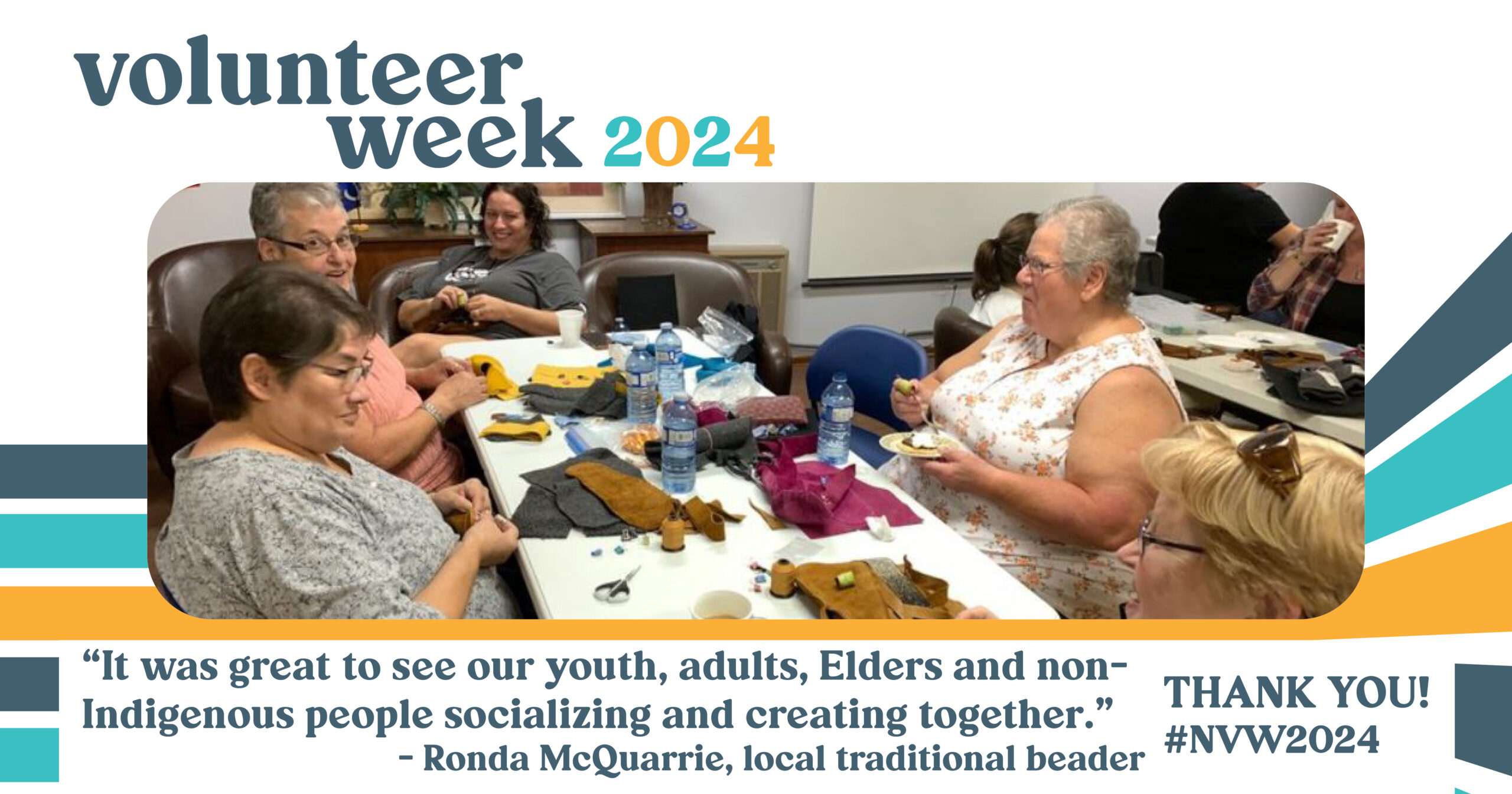
The community recognized the importance as well and the workshop filled up quickly hosting 21 participants – the largest group McQuarrie has instructed within her facilitation work. “It was great to see our youth, adults, Elders and non-Indigenous people socializing and creating together.”

Participants were able to work with moose hide, beaver fur and glass seed beads. With the help and guidance of McQuarrie, they were all able to produce a pair of authentic, hand-stitched, traditional Métis, floral-beaded moccasins, created specifically in a Métis beading style.

“The participants really seemed to enjoy the class and were very happy with their completed moccasins,” she says. “I have had a few people ask me questions since about making more moccasins. [There is a] definite interest in participating in future projects like this one.”

As with any successful event, volunteers, also referred to as ‘Helpers’ in Indigenous communities, played a big role in the delivery of the moccasin-making workshop. McQuarrie says that, the helpers for an event, such as the beading workshop, are largely family and relatives of members of the local who regularly donate their time for community gatherings and events. “Most of this is very informal,” she explains, “and if there is a need for something to get done, they just seem to step up and do it.”

Furthermore, McQuarrie shares, that she is also a volunteer. Her knowledge and skill-set to refine beadwork and moccasin-making, as well as the preparation involved to facilitate, are all done on her own time.

With a successful turnout and eager participants, McQuarrie says that many have continued to work on their beading skills outside of the workshop. “They are taking up this art form and embracing this aspect of their culture,” she says. “They are now able to share it with their children and grandchildren. This class could lead to an intergenerational sharing of culture.”

McQuarrie hopes that more projects like this will continue to happen in her community so she can share her gift with others. “I would love to be able to teach a class on [making] gauntlet mitts, and continue to teach different beading techniques to the community.”

This project received support through the Métis Cultural Development Fund, administered by Gabriel Dumont Institute on behalf of SaskCulture, and funded by Sask Lotteries Trust Fund for Sport, Culture and Recreation.

Charlie Biemans dedicates himself to his community

This volunteer recognition story and photo is courtesy of the Prairie Central District for Sport, Culture and Recreation 

Volunteers have the ability to adapt to the particular needs of an organization and situation. Charlie Biemans stands as an example of the diverse skills exhibited by Saskatchewan volunteers. 

For 43 years, Biemans has dedicated himself Englefeld’s community through numerous roles at the local school.  

In his free time, he has followed his passion for sport and coached youth in baseball, softball, volleyball, track, badminton, soccer, hockey and curling.  

Biemans continues to take the lead role in making the curling and skating ice for winter activities in the local arena. He manages the rink schedules, ice rentals, opening and closing, cleaning and maintenance, and ensuring the kitchen is fully stocked with supplies. 

He has an ability to create community, as Biemans has planned evenings at the local rink that feature burgers and free skating. 

Over the years, Charlie has spent time on the Englefeld Rec Board, village council and has supported the installation of new playground equipment at the park as well as renovations to the arena. 

“Englefeld is a better place because of the countless hours of volunteer time Charlie dedicates to the community. He is the driving force behind the Rec Board,” said fellow community member, Deanna Miskolczi. “As soon as one community event is over, Charlie is already talking about the next one!” 

In December 2023, Charlie was recognized with a Volunteer Recognition Award from the Prairie Central District for Sport, Culture and Recreation. Congratulations, Charlie! 

National Volunteer Week April 14-20

Saskatchewan’s 330,000 volunteers are a vital part of the foundation that makes up Saskatchewan’s sport, culture and recreation system. From April 14-20, celebrated under the theme of “Every Moment Matters,” volunteers will be recognized nationwide for their contributions. For 50 years, Sask Lotteries has funded volunteer led sport, culture and recreation programs in the province and it is through the contribution of volunteers that we can make a difference.

Sask Lotteries knows that every second a volunteer gives to the community, an innumerable number of individuals feel the impact. As part of the celebration, Sask Lotteries, along with Sask Sport is saying thank you to the volunteers in Saskatchewan, who help make the 12,000 lottery-funded sport, culture and recreation activities possible.

When thanking volunteers on social media, organizations are encouraged to use the hashtags: #NVW2024, #EveryMomentMatters.

For more information on the week and access to National Volunteer Week assets, check out SaskSport.ca